
The stars and us
“We are all made of star stuff.” My thoughts often wander to this famous quote from one of my favorite authors, Carl Sagan. I think it’s such an elegant statement to ponder our cosmic existence, one that casually blurs the line between science and poetry. But what does it mean to be made of star stuff? Well, the beauty of this phrase is in its literal meaning, for we are indeed made of star stuff.
Our planet Earth is abundant in chemical elements. Rocks contain minerals, which are typically composed of oxygen and silicon atoms in fancy arrangements. Trees are huge masses of mostly carbon, oxygen, and hydrogen atoms, while clouds are fluffy bundles of water molecules built from hydrogen and oxygen atoms. Our human body is likewise a rainbow of chemical elements. Hemoglobin, the protein that gives blood its red color, contains iron. Nitrogen is in the nitrogenous bases that make up the double helical structure of our DNA. Our very own heartbeat relies on the movement of sodium, calcium, and potassium ions. At the heart of our existence are simple atoms organized and interacting in complicated ways.
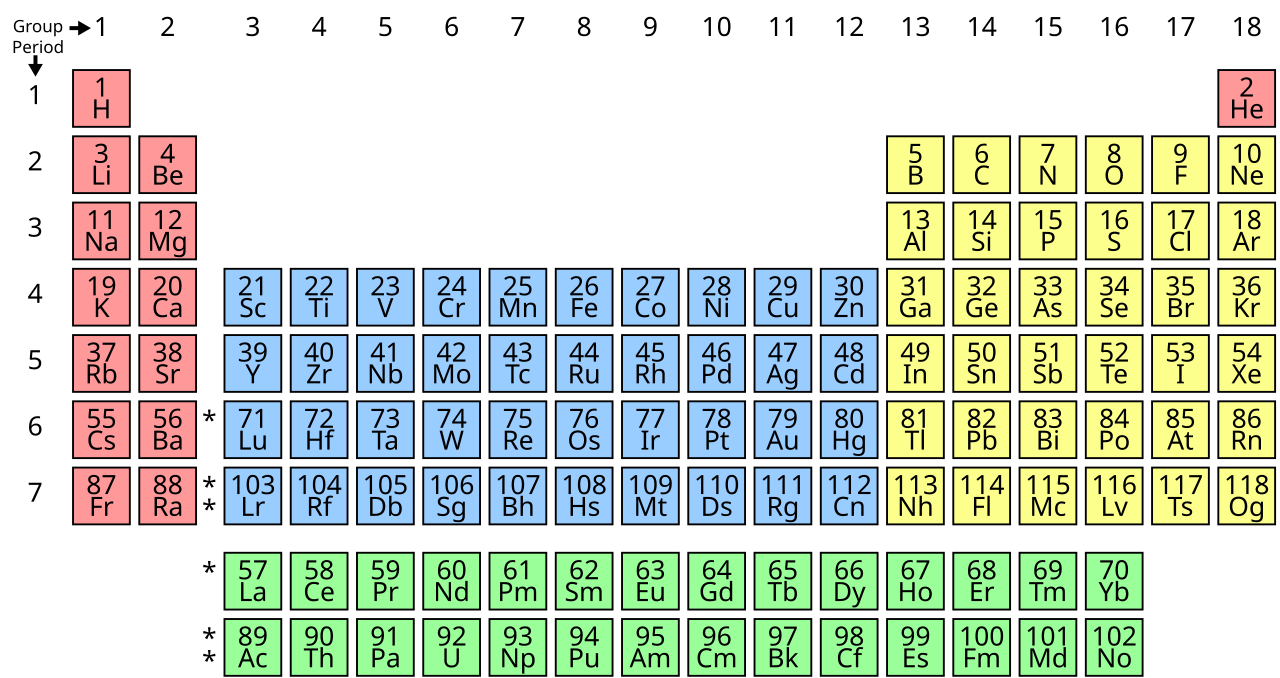 The periodic table.
The periodic table presents all the 118 chemical elements we know so far. Many of the elements found here on Earth are also widespread in our Solar System. And the same elements also exist in other parts of our Milky Way galaxy, and even in other, much farther galaxies. But where did these elements come from? How are hydrogen, oxygen, and carbon formed?
The universe is composed of around 99% hydrogen and helium, the two lightest elements. Hydrogen and helium were created shortly after the Big Bang, when the universe was only 3 minutes old. The other 1% is composed of the rest of the elements in the periodic table. The answer to the question of their origin is quite amazingly written in the stars.
The star stuff
About a century ago, Sir Arthur Eddington had speculated nuclear fusion of hydrogen—the process of hydrogen atoms fusing together to form a helium atom—to be the primary source of power in stars. The amount of energy released during this reaction provides the pressure support needed to prevent the star from collapsing under its own weight. Evidence for this claim didn’t come until later when more studies were conducted, including the analysis of the Sun’s composition by Cecilia Payne. We cannot talk about star stuff without ever mentioning the revolutionary work of Cecilia Payne. For the longest time, astronomers believed that the Sun shares the same composition as Earth’s. In her 1925 thesis, Cecilia Payne studied the light spectra of stars and showed that the Sun is instead a ball of hydrogen and helium, with some traces of terrestrial elements.
“The outstanding discrepancies between the astrophysical and terrestrial abundances are displayed for hydrogen and helium. The enormous abundance derived for these elements in the stellar atmosphere is almost certainly not real.” – from Payne’s PhD thesis.
Her findings, which must have baffled her and which initially faced criticisms from prominent astronomers at the time, demonstrated that the hydrogen needed to fuel nuclear fusion is present in abundance in stars. Cecilia Payne’s work is often cited as the “most brilliant PhD thesis ever written in astronomy”, as it laid the pillars for the edifice that is the origin of elements.
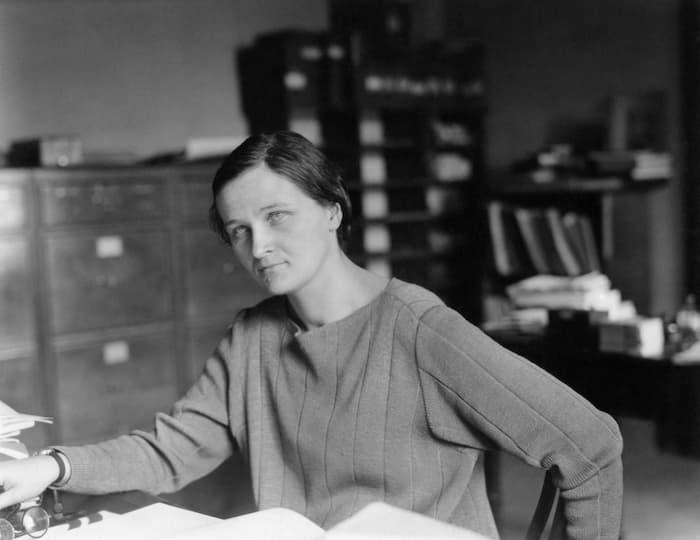 Cecilia Payne.
Stellar nucleosynthesis
In the 1950s, the popular notion was that all elements were produced in the primordial state of the universe, that the elements were all created around the time of the Big Bang. These primordial theories would imply that the chemical elements are uniformly distributed across the ever-expanding fabric of space and time. However, real observations were found to contradict this prediction, as stars at different ages exhibit differences in their chemical composition. In 1957, the groundbreaking paper entitled “Synthesis of the Elements in Stars” was published by Burbridge, Burbridge, Fowler, and Hoyle, in what came to be famously known as the B2FH paper. Here, the authors proposed that chemical elements are manufactured inside the stars in a process called stellar nucleosynthesis (stellar [star] + nucleo [nucleus] + synthesis [putting together]).
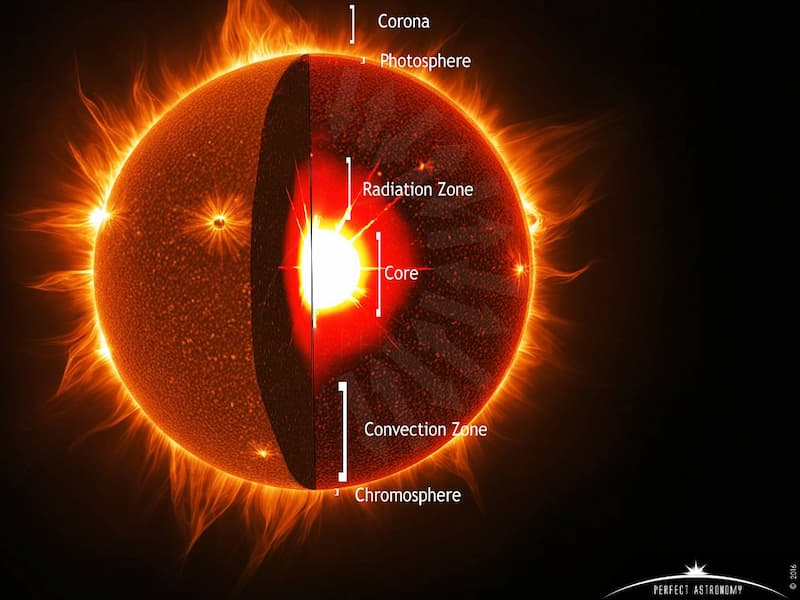 Internal structure of a star.
“Man inhabits a universe composed of a great variety of elements and their isotopes…It is our view… that the stars are the seat of origin of the elements.” – from the B2FH paper.
Hydrogen atoms, which exist in abundance in stars, fuse together to form helium atoms. This occurs in the cores of stars, at temperatures of at least 10 million degrees Celsius! This hydrogen-burning process releases massive amounts of radiation energy and pressure that counteract the gravitational force, keeping the star in equilibrium. A star spends around 90% of its lifetime converting hydrogen into helium in its core. Once it has exhausted its hydrogen reserve, the star officially enters its dying phase. With depleted energy from hydrogen fusion, gravity starts to win the stellar tug-of-war game, causing the star’s core to shrink. The now compact state of the core, however, increases the core’s pressure and temperature and triggers a new set of nuclear reactions. The increased temperatures now allow for the unfused hydrogen in the surrounding layers to burn, creating a hydrogen-burning shell around the helium core. The energy produced from this shell causes the outer layers to expand dramatically, and the star becomes a red giant star. As the core continues to contract, it becomes hot enough to spark helium burning. It is this nuclear fusion among helium atoms that produces the heavier carbon and oxygen atoms.
We now have four elements in our cosmic candy bag of elements: hydrogen, helium, carbon, and oxygen. We can pause to appreciate the star’s hard work. We cannot make hemoglobin and DNA quite yet, but our carbon-based life is one element closer to reality. The formation of other elements occurs in the later stages of the star’s death, whose manner depends on the star’s initial mass. As with hydrogen burning, the nuclear reaction of helium atoms into carbon and oxygen continues until the helium fuel runs out. Stars less than 8 times the mass of the Sun (Msun) undergo a series of contractions until their outer layers are eventually shed into the surrounding space. The shed material forms a planetary nebula, while the stellar remnant becomes a white dwarf, a dense core of carbon and oxygen where nuclear reactions have ceased.
Meanwhile, stars with masses above 8 Msun experience a more dramatic ending. The massive gravity of these stars allows further burning of the heavier elements. Following helium-burning are carbon-, neon-, oxygen-, and silicon-burning that produce the unicorn of chemical elements up to iron. Once the core becomes dominated by iron, however, the resulting nuclear reaction is no longer exothermic (i.e., energy-releasing), and the inescapable gravitational collapse compresses the iron atoms to the point of shredding them into their skeletal protons, neutrons, and electrons. The eventual reactions among these tiny particles produce an outward shock that drives a powerful explosion called a supernova. A supernova is therefore a star’s blasting goodbye. What remains of it is a very dense neutron star or, if it’s heavy enough, a black hole.
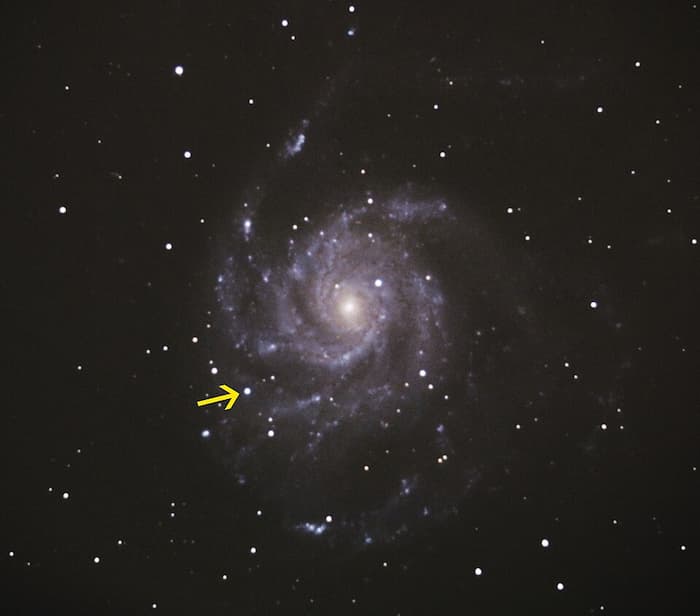 A supernova event discovered on August 24, 2011 (highlighted by a yellow arrow) in the Pinwheel Galaxy.
We’ve added a couple more flavors in our cosmic candy bag, but we have the rest of the periodic table left untouched. How about the elements past iron? How are gold and xenon formed, for example? To this end, we are still putting the puzzle pieces together. If we look at the periodic table again, each element is uniquely tagged by its atomic number. The atomic number is simply the number of protons contained in the nucleus of that element’s atom. In stellar environments, these nuclei are surrounded by free particles swimming in the stellar plasma. Sometimes, a free neutron would zoom close enough to a stable nucleus (like iron) to be captured by that nucleus. The captured neutron would create an unstable nucleus, triggering a round of nuclear reactions that eventually bring the excited nucleus to a more stable state. This reaction involves a certain type of radioactive decay that converts a neutron into a proton, thereby raising the atomic number by one. We have transformed the original element into a different, heavier one. This process of neutrons being captured to form a heavier element is called a neutron capture, and is how most of the elements heavier than iron are formed.
The stars and us
In the space where stars once lived is a nebula enriched with the stars’ chemical remains. Some millions or billions of years later, the gas in that nebula may become dense enough and collapse to form a new star. A short distance away from this particular star, a certain rocky planet may form, gathering some of the iron and nickel residue to form its core. Four billion years later, this planet will be home to human beings, a reincarnation of carbon and other stellar elements who will learn and love to gaze at the twinkling stars above.
The study of the origin of elements remains an active field of research. A complete picture of the astrochemical puzzle continues to evade us, but we have stolen puzzle pieces aplenty from the universe’s age-old grip. We have learned that we are more connected to the universe than we realize. We are made of star-stuff. The iron pulsing in our veins, the nitrogen linking our DNA, the oxygen filling our lungs with life—all these are gifts from the stars. Isn’t that phenomenal? The universe breathes in us and in all other creatures on Earth. Our body and mind blinked into existence in the infinite void of space and time, sustained by the chemicals of stars that died.
- Burbidge, E. M., Burbidge, G. R., Fowler, W. A., & Hoyle, F. (1957). Synthesis of the elements in stars. Rev. Mod. Phys., 29(4), 547–650. https://doi.org/10.1103/RevModPhys.29.547
- Sagan, C. (1980). Cosmos. New York: Random House.
- Johnson J. A., Fields B. D., Thompson T. A. (2020). The origin of the elements: a century of progress. Phil. Trans. R. Soc. A 378:20190301. http://dx.doi.org/10.1098/rsta.2019.0301
- Payne-Gaposchkin, C. H. (1925). Stellar Atmospheres: A Contribution to the Observational Study of High Temperature in the Reversing Layers of Stars. PhD thesis, (Radcliffe College, Cambridge, MA)
- https://science.nasa.gov/universe/overview/